

If Your Jaw Hurts, Why Am I Looking at Your Tongue? Because your tongue isn't just along for the ride.
If you've ever had a TMJ assessment with me, there's usually a point when I ask you to do something that seems completely unrelated to the reason you came in:
Stick out your tongue.
Then I might ask you to move it from side to side, lift it toward the roof of your mouth, swallow, breathe through your nose or show me where your tongue naturally rests.
If you came in because your jaw hurts, clicks, feels tight or isn't moving properly, you might reasonably wonder:
What does any of this have to do with my jaw?
Potentially, quite a bit.
Your jaw doesn't work by itself
We tend to think of the jaw as a hinge that simply opens and closes.
In reality, your jaw is part of a much larger functional system involving the temporomandibular joints (yes, there are two), muscles of mastication, tongue, lips, cheeks, floor of the mouth, hyoid region and other structures involved in breathing, chewing, swallowing and speaking.
These structures don't perform their jobs independently.
Your tongue and jaw have to coordinate every time you chew and swallow. Research in people with TMD has identified relationships between tongue mobility, tongue pressure and swallowing function, although we're still learning exactly how these relationships contribute to different TMD presentations.
That's why assessing a jaw without considering how the rest of the orofacial system functions can leave part of the picture unexplored.
Where does your tongue rest?
Here's something most people have never thought about:
Where is your tongue when you're doing absolutely nothing?
Not talking.
Not eating.
Not swallowing.
Just sitting there.
Resting posture is one of the things I look at during an assessment because it tells me something about how your orofacial system is functioning throughout the day—not just during the few seconds when you open and close your mouth for me.
I may look at whether the tongue rests low in the mouth, whether it contacts the palate, whether it sits between or against the teeth, and what the lips and jaw are doing at the same time.
I also want to know why that resting position exists.
For example, if someone habitually rests with their mouth open, simply telling them to “put your tongue on the roof of your mouth” doesn't answer the more important question:
Why isn't it already there?
That may lead us to look further at tongue mobility, nasal breathing, oral habits or other structural and functional factors.
And importantly, an unusual resting posture doesn't automatically mean we've discovered the cause of someone's jaw pain.
It's a finding (I call them breadcrumbs) — not a diagnosis.
Can your tongue move independently of your jaw?
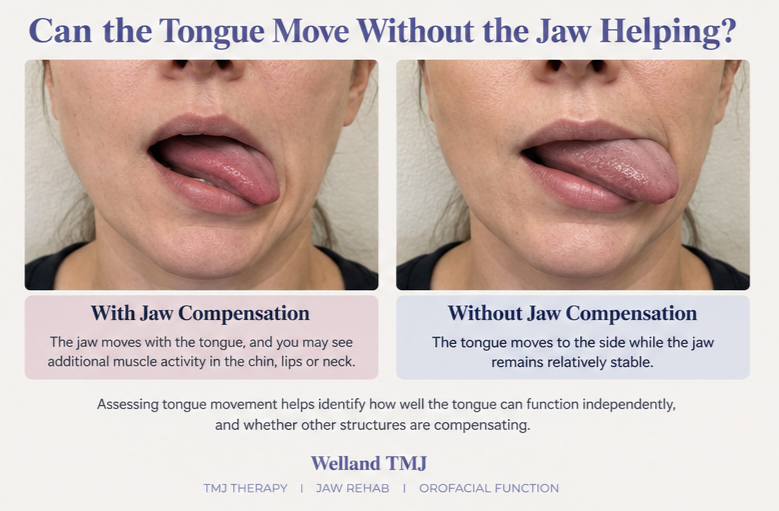
This is one of my favourite things to assess.
I may ask someone to move their tongue and suddenly their jaw moves with it.
Or their lips tighten.
Their face shifts.
Their entire head starts helping.
Sometimes people can perform the movement—but only by recruiting several other structures to get there.
Those compensations give me information.
One of the things we're looking for is motor control: can the tongue perform the movement we're asking of it without unnecessary help from the jaw, lips or face?
Research examining people with TMD has found associations between tongue mobility, oral motor control and swallowing performance. That doesn't mean impaired tongue movement caused the TMD. It does tell us that tongue function can be relevant when we're evaluating how the entire orofacial system is working.
Then I watch you swallow
Swallowing is something you do hundreds of times throughout the day without thinking about it.
But from a functional perspective, quite a lot has to happen in a very coordinated sequence.
Your tongue helps control and move what you're swallowing, while the jaw and surrounding muscles participate in stabilizing and coordinating the oral phase of the process.
Research has identified swallowing-related changes in some people with TMD, although swallowing impairment is certainly not present in everyone with a temporomandibular disorder. One systematic review found that swallowing itself was impaired in a minority of patients, while other chewing-related complaints such as pain and fatigue were considerably more common.
During an assessment, I may therefore look at things like tongue movement during the swallow, lip or facial recruitment, jaw movement and other compensatory patterns.
Again, we're not looking for one “wrong” swallow that explains your jaw pain.
We're asking:
Does the way this person is functioning give us useful information about their overall presentation?
What about a tongue-tie?
This is another reason tongue assessment matters—but it's also an area where we need to be careful.
A lingual frenulum is normal anatomy. Having a visible or prominent frenulum does not automatically mean someone has a problematic tongue-tie, and appearance alone doesn't tell us how well the tongue functions.
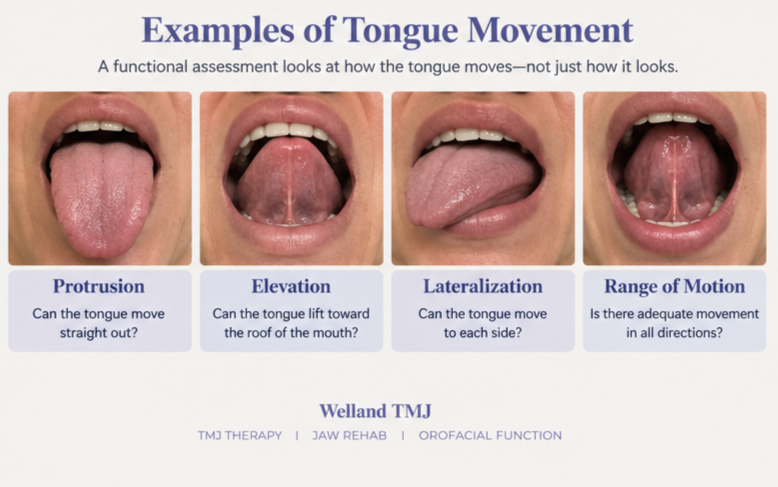
That's why I'm much more interested in function.
Can the tongue perform the movements we need?
Is mobility restricted?
Are other structures compensating?
Does the finding appear relevant to the person's symptoms and functional goals?
And if I identify something that may warrant further assessment, that doesn't mean I'm automatically recommending a release. It may mean collaboration with another appropriately trained healthcare provider is warranted.
So... is your tongue causing your TMJ problem?
Not necessarily.
And that's probably the most important point in this entire article.
TMD is complex and multifactorial. There usually isn't one structure, one habit or one finding that explains everything.
Your tongue may be completely irrelevant to your particular symptoms.
Or tongue mobility, resting posture, swallowing, breathing or compensatory movement patterns may represent one piece of a much larger clinical picture.
That's why I assess rather than assume…. “ASSESS DON’T GUESS”
The goal isn't to find something “wrong” with every person who walks through the door.
The goal is to understand how your system functions, where it may be compensating, and which findings are actually relevant to the problem you're experiencing.
Your jaw is part of a system
So if you come in because your jaw hurts and suddenly I'm watching your tongue, your breathing, your neck and the way you swallow...
I haven't forgotten why you're there.
I'm trying to understand the whole picture.
Because sometimes the place you feel the problem isn't the only place worth looking.“How is my jaw actually functioning?”
Experiencing persistent jaw pain, tightness, clicking or difficulty opening?
A comprehensive TMJ assessment looks beyond where it hurts to examine how your jaw and surrounding systems are actually functioning.
Sources
Rosa RR, et al. Tongue function and swallowing in individuals with temporomandibular disorders. Journal of Applied Oral Science. 2020;28:e20190355.
Gilheaney Ó, et al. The prevalence of oral stage dysphagia in adults presenting with temporomandibular disorders: a systematic review and meta-analysis. Acta Odontologica Scandinavica. 2018.
***
About The Author
Melissa Violette, RMT, is @thetongueandjawtherapist . She is a Registered Massage Therapist in Ontario and the founder of Welland TMJ, a clinic focused on the assessment and management of jaw-related pain and dysfunction. Melissa has advanced training in temporomandibular joint disorders (TMJD), myofunctional therapy, and soft tissue–based approaches to jaw, neck, and facial pain. Her work emphasizes thorough assessment, education, and individualized care to help patients better understand the factors contributing to their symptoms.
To book an appointment, visit Welland TMJ Booking
Medical Disclaimer
The content on this blog is intended for general educational and informational purposes only. It is not intended to replace professional medical advice, diagnosis, or treatment. Always seek the guidance of a qualified healthcare provider with any questions you may have regarding a medical condition or treatment plan.